
How to Plan Your Day: A Realistic Step-by-Step Guide
Plan a day you can actually follow. Work out your real free time, pick priorities, estimate tasks and time-block a schedule that survives interruptions.
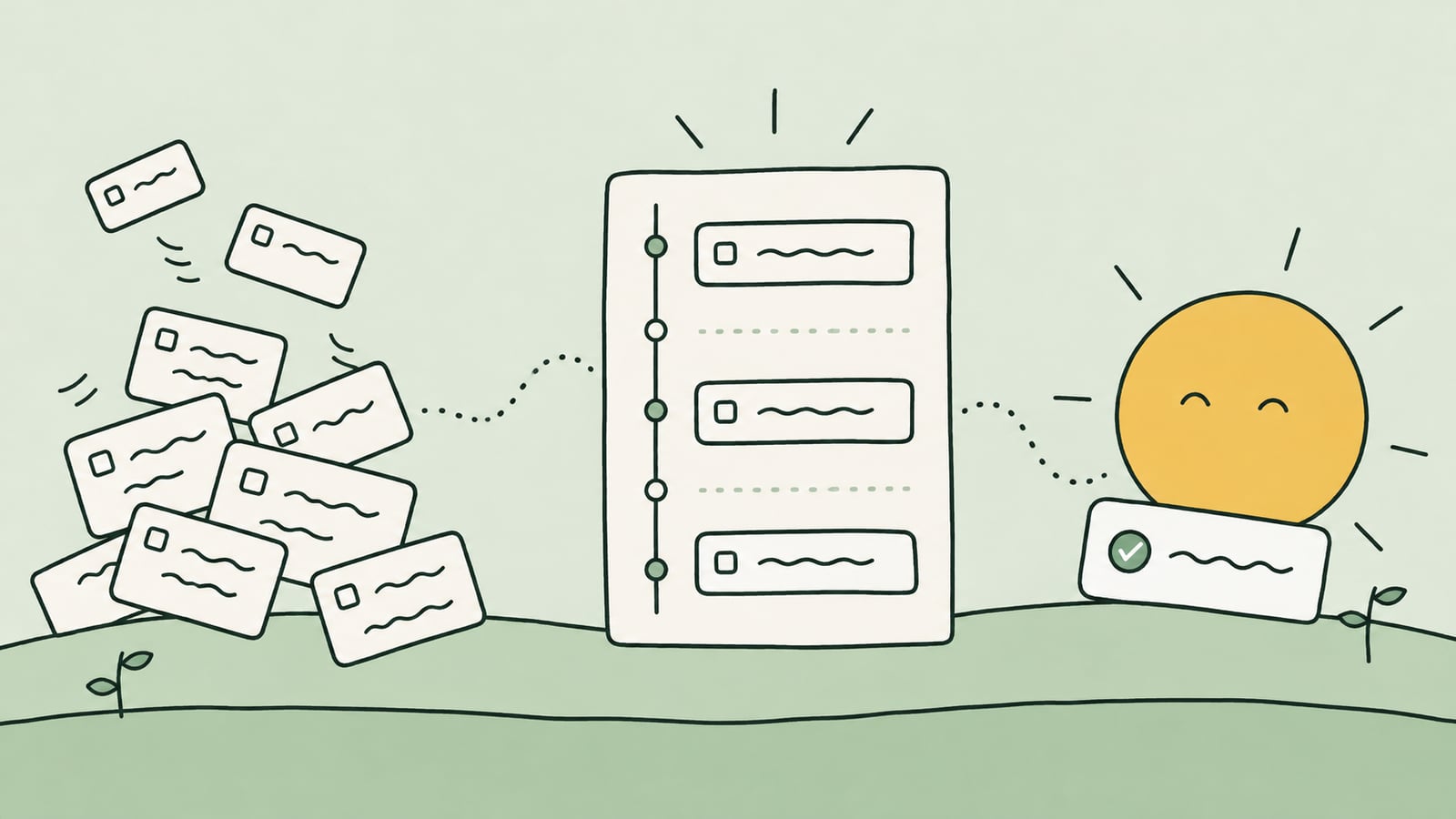
A useful daily plan answers three questions: What matters today? How much time do I really have? What will I move if the day changes? Start with your fixed commitments, choose a small set of meaningful tasks, and give those tasks realistic time. Leave some space unclaimed.
The trouble usually begins when we turn an entire to-do list into today’s promise. A list is a place to keep work. A daily plan is a decision about what to do with a limited day. You need both, but they serve different purposes.
This guide walks through that decision, with a complete 09:00–17:00 example, a comparison of popular daily planning methods, a reusable checklist and adjustments for study, freelance work and meeting-heavy days. You can use paper, a notes app or a planner. The method does not require buying anything.
The short version
- Work out how many hours you really have once meetings and breaks are counted.
- Do a brain dump, then pick one main outcome for the day.
- Estimate each task from start to finish, including setup.
- Check the total against your free time and move what doesn't fit.
- Time-block the important work and keep a buffer.
- Review the day in five minutes and adjust tomorrow.
1. Work out how much time you really have
Write down the beginning and end of the period you are planning. Then mark commitments you cannot freely move: meetings, appointments, classes, travel and meals. Put them in their actual positions, rather than treating them as one vague distraction.
For example, eight hours from 09:00 to 17:00 gives you 480 minutes. A thirty-minute lunch and a thirty-minute meeting use sixty of those minutes. Reserve another thirty minutes for breaks and small interruptions. That leaves 390 minutes for tasks, not eight hours.
Do not count the same time twice. If lunch is already a fixed commitment, do not include it again in your buffer. If your working window starts after the commute, you do not need to subtract the commute from it.
Will your day fit?3 h over Try the free calculator with your own tasks →The calculator checks the totals. You still need to check whether the actual gaps between appointments are long enough for the work.
2. Do a brain dump, then choose
Make one capture list for unfinished work, errands, questions and ideas. At this stage, record them without assigning everything to today. Keep tomorrow’s possibilities out of today’s commitment.
Turn vague projects into visible next actions. “Website” is difficult to estimate. “Draft the homepage introduction” has a clearer starting point and finishing point. “Exam preparation” might become “Answer ten practice questions, then review the mistakes.”
If a task depends on someone else, note who or what you are waiting for. A task you cannot start is not a good candidate for your best working block. You might instead plan the next action that unblocks it, such as preparing a question or gathering the missing material.
3. Prioritize: pick one main outcome
Ask which task has a real consequence if it waits, which moves an important project forward, and which is ready to start. Check deadlines before relying on the feeling that everything is urgent.
Choose one main outcome you want to protect. Then add supporting work only while the time budget allows it. There is no universally correct number of daily tasks: six small admin jobs and six substantial writing tasks represent very different days.
Separate a deadline from a planned work date. A proposal due on Friday might need a drafting block on Tuesday. Scheduling Tuesday’s work does not change Friday’s deadline, and waiting until Friday to put it on a daily list can create avoidable pressure.
Keep a “later” list you trust. Postponing work deliberately is a planning decision, not losing it. If postponement would affect another person or a deadline, address that constraint instead of quietly moving the date forever.
4. Estimate each task from start to finish
For each candidate, write a rough duration that includes preparation, the main activity and the time it takes to wrap up. A call may require ten minutes to gather notes and another ten to record decisions. An article draft may need checking and formatting before it is ready to share.
For unfamiliar work, break the task down or give it a first exploration block. “Investigate the error for thirty minutes and record the next step” is more honest than promising to fix an unknown problem in thirty minutes.
Here is an illustrative task list. These estimates are examples, not benchmarks for how quickly anyone should work.
| Task | Estimated minutes |
|---|---|
| Prepare a client proposal | 120 |
| Review a design | 90 |
| Draft an article | 60 |
| Answer emails | 30 |
| Send invoices | 20 |
| Finish administrative work | 40 |
| Research a new idea | 90 |
| Update the website | 120 |
| Total | 570 |
With 390 minutes available, the list exceeds capacity by 180 minutes. Making the boxes smaller does not make the work smaller. For this example, defer research and the website update, removing 210 minutes. The remaining six tasks total 360 minutes, leaving thirty minutes beyond the buffer already reserved.
5. Time-block your day
Give your main task a suitable block, ideally during a period when you can concentrate. Then fit smaller tasks around your fixed commitments. Group similar admin work when it reduces repeated setup, but do not postpone a genuinely urgent reply just to preserve a neat batch.
The example below fits the selected 360 minutes around lunch and the meeting. Two short breaks use the thirty-minute buffer; the final thirty minutes remain unallocated.
| Time | Plan |
|---|---|
| 09:00–11:00 | Client proposal |
| 11:00–11:15 | Break |
| 11:15–12:45 | Design review |
| 12:45–13:15 | Lunch |
| 13:15–14:15 | Article draft |
| 14:15–14:45 | Meeting |
| 14:45–15:15 | Emails |
| 15:15–15:35 | Invoices |
| 15:35–15:50 | Break |
| 15:50–16:30 | Administrative work |
| 16:30–17:00 | Unallocated time |
A fitting total does not guarantee a fitting schedule. If appointments divide the morning into twenty-minute gaps, a two-hour proposal block will not fit there. Move it to a suitable period, split it into meaningful stages or choose a different day.
6. What to do when your plan falls apart
When the day changes, pause before squeezing every remaining task into less time. Ask what changed, how much usable time remains and which outcome is still worth protecting.
If a meeting runs an hour late, choose what to remove, shorten or move. Recheck deadlines and dependencies. Change the remaining plan once, rather than repeatedly dragging the same unfinished task through the afternoon. In Sunlet you can describe the change in a sentence and the Assistant proposes what to move; nothing changes until you confirm it.
A buffer gives you options; it is not a guarantee against disruption. Some days require a much smaller plan. Finishing the important task and consciously moving the rest can be a better outcome than ending with an impossible list and no clear next step.
7. Review your day in five minutes
Spend a few minutes asking: What did I finish? What took longer than expected? What needs a different plan tomorrow?
Record a more realistic estimate for work you do regularly. If a review repeatedly takes ninety minutes rather than forty-five, your next plan should reflect that observation. A short manual note is enough; you do not need to turn the review into another project.
Move unfinished work deliberately. Give it a new work date, return it to the backlog, reduce its scope or remove it if it is no longer needed. An overdue label alone does not tell you which choice is right.
Daily planning methods compared
The steps above work with any popular planning method. These are the ones people ask about most, and when each one helps.
| Method | How it works | Works best for |
|---|---|---|
| Time blocking | Give each important task its own slot in the day. | Deep work and days with fixed hours. |
| The 1-3-5 rule | Plan one big task, three medium ones and five small ones. | Mixed to-do lists that need a limit. |
| Eat the frog | Do the hardest or most avoided task first. | Work you keep postponing. |
| The Ivy Lee method | The evening before, list six tasks in order and work through them one at a time. | Simple, repeatable routines. |
| The Eisenhower matrix | Sort tasks by urgent and important, then drop or delegate the rest. | Deciding what not to do. |
You don't have to choose one. A common mix is to pick the day's main outcome with the Eisenhower matrix, size the list with 1-3-5, then time-block the big task.
Adapt the method to your day
For study: include classes, travel and breaks before choosing revision tasks. Define the topic or exercise set. “Study all afternoon” gives you less guidance than “Review chapter three and answer the practice questions.”
For freelance work: protect client deadlines, account for communication and admin, and distinguish paid delivery from business development. Do not let every incoming message rewrite the whole plan.
For a meeting-heavy day: use short gaps for tasks that genuinely fit them. Reserve deep work for a longer open block or another day. A fragmented day may have spare minutes without spare concentration.
A five-minute daily-planning checklist
- Mark the hours you have and the commitments already fixed.
- Reserve breaks and a buffer without counting anything twice.
- Capture loose tasks, then choose the main outcome for today.
- Estimate complete tasks and compare the sum with available time.
- Place the chosen work into suitable gaps; leave some time unclaimed.
- Decide what can move if the day changes.
Sunlet is built around this routine: capture into Inbox, add estimates, and arrange the day in Today and Week while it shows how much time is left. See all features or try the demo with sample tasks.
Common questions
Should I plan in the morning or the evening?
Either can work. An evening draft helps you leave unfinished thoughts somewhere reliable; a morning check catches new commitments. Choose the routine you can repeat, and keep the update brief.
How much buffer should I leave?
Use your actual interruptions and uncertainty as a starting point. Thirty minutes is the example in this guide, not a universal recommendation. A day with new work, travel or unpredictable calls needs more flexibility.
What if I never finish my daily list?
Check capacity, task size and interruptions before adding more discipline rules. Reduce the plan, make vague tasks concrete, and compare estimates with what happened. If the same task keeps moving, investigate what prevents it from starting.
Do I need to time-block every task?
No. Reserve blocks where a specific time helps, and keep small flexible tasks in a short list. The purpose is to make realistic decisions and start useful work. A beautiful schedule that takes longer to maintain than to follow needs simplifying.
Also available in Dansk · Deutsch · Español · Suomi · Français · Italiano · 日本語 · Norsk · Nederlands · Polski · Português (Brasil) · Português · Svenska